- Teacher: Monica Aejmelaeus
- Teacher: Tuulaliina Asumalahti
- Teacher: Matias Ingman
- Teacher: Kaisa Kanerva
- Teacher: Antti Kankkunen
- Teacher: Taru Korkalainen
- Teacher: Taru Lyly
- Teacher: Ilkka Partonen
- Teacher: Aune Rummukainen
- Teacher: Jarmo Tapio
- Teacher: Viivi Välttilä
Metropolia Moodle
Search results: 1524
- Teacher: Monica Aejmelaeus
- Teacher: Tuulaliina Asumalahti
- Teacher: Matias Ingman
- Teacher: Kaisa Kanerva
- Teacher: Taru Lyly
- Teacher: Ilkka Partonen
- Teacher: Aune Rummukainen
- Teacher: Jarmo Tapio

- Teacher: Liisa Seppänen

- Teacher: Mari Heitto
- Teacher: Miia Penttinen
- Teacher (A): Satu Vahaluoto

- Teacher: Mari Heitto
- Teacher: Miia Penttinen
- Teacher: Anna Puustelli-Pitkänen
- Teacher: Satu Vahaluoto

- Teacher: Heidi Oilimo
- Teacher: Miia Penttinen
- Teacher: Satu Vahaluoto

- Teacher: Elisa Mattila
- Teacher: Anna Puustelli-Pitkänen
- Teacher: Taina Valkeapää
- Teacher: Heidi Wahl
- Teacher (A): Jasu Forss
- Teacher (A): Mikaela Mansikkala

- Opettaja: Tomi Hämäläinen
- Opettaja: Lotta Heinonen
- Opettaja: Elina Hovila

- Teacher (A): Tomi Hämäläinen
- Teacher (A): Lotta Heinonen
- Teacher (A): Päivi Salminen

- Teacher: Soile Bergström
- Teacher: Ulla Saukkonen

- Teacher: Soile Bergström
- Teacher: Ulla Saukkonen
- Teacher: Anna Puustelli-Pitkänen
- Teacher: Satu Vahaluoto

- Teacher: Mari Heitto
- Teacher: Miia Penttinen
- Teacher: Mari Heitto
- Teacher: Mikaela Mansikkala
- Teacher: Heidi Oilimo
- Teacher: Miia Penttinen
- Teacher: Satu Vahaluoto

- Teacher: Sylvia Hakari
- Teacher: Leena Korhonen
- Teacher: Anu-Helena Pitkänen
- Teacher: Katja Sidoroff

- Teacher (A): Heidi Wahl
- Teacher: Hanna Järvinen
- Teacher: Krista Puhakka

- Teacher: Tomi Hämäläinen
- Teacher: Lotta Heinonen
- Teacher: Hanna Järvinen
- Teacher: Jenni Pöllönen
- Teacher: Krista Puhakka

- Teacher: Laura Kivistö
- Teacher: Merja Kosonen
- Teacher: Liisa Heikkilä
- Teacher: Lotta Heinonen
- Teacher: Hanna Järvinen
- Teacher: Raisa Kallio
- Teacher: Suvi Ollikainen
- Teacher: Tiina Vihavainen

Tämä on orientaatio Kuntoutuksen ammatillisen väylän opintoihin. Täällä saat yleisen tiedon siitä, mitä opintoja väylään kuuluu ja mitä tavoitteita kullakin opintojaksolla on. Tämä orientaatio on tarkoitettu vain ja ainoastaan väyläopiskelijoille.
- Teacher: Jouni Arffman
- Teacher: Jasu Forss
- Teacher: Riikka Jokimäki
- Teacher: Eva-Kristina Nyström
- Teacher: Heidi Wahl

- Teacher: Hanna Aho
- Teacher: Jukka Kesänen
- Teacher: Anna-Kaisa Partanen
- Teacher: Riikka Sorri

- Teacher: Sylvia Hakari
- Teacher: Taina Konttinen
- Teacher: Eveliina Korpela
- Teacher: Anne Lipasti
- Teacher: Heli Määttänen
- Teacher: Hilla Niemi
- Teacher: Elina Nissinen
- Teacher: Lilli Rasilainen
- Teacher: Tanja Saariaho
- Teacher: Mai Salmenkangas
- Teacher: Jukka Törnroos

- Teacher: Pasi Kovanen
- Teacher: Nadja Marjomaa
- Teacher: Janne Nuotio
- Teacher: Katja Salminen
- Teacher: Mia Sjöholm

- Teacher: Oksan Niemi
- Teacher: Ann-Sofie Shevlane

Moodle platform for Orientation to Metropolia studies in IT.
- Teacher: Marianne Autero
- Teacher: Anna Hynninen
- Teacher: Marja Koskua
- Teacher: Janne Salonen

- Teacher: Natasa Anttila
- Teacher: Terhi Dahlman
- Teacher: Mika Hämäläinen
- Teacher: Annamari Ikonen
- Teacher: Päivi Karhumetsä
- Teacher: Nea Kivekäs
- Teacher: Maarika Kortelainen
- Teacher: Roope Rannikko
- Teacher: Mari Rupponen
- Teacher: Ann-Sofie Shevlane
- Teacher: Jenni Torikka
- Teacher: Suvi Väänänen
- Teacher: Raisa Varsta

- Teacher: Tania Chumaira
- Teacher: Turkka Loimisto
- Teacher: Markku Luotonen

- Teacher: Hanna Aho
- Teacher: Jukka Kesänen
- Teacher: Johanna Kivikangas
- Teacher: Anna-Kaisa Partanen
- Teacher: Riikka Sorri

- Teacher: Katja Hänninen
- Teacher: Henna-Liisa Palojärvi

- Teacher: Katja Hänninen
- Teacher: Terhi Kaunismäki
- Teacher: Anna Niinitanner
- Teacher: Paula Ojanen
- Teacher: Henna-Liisa Palojärvi
- Teacher: Merja Räty
- Teacher: Mari Rupponen

- Teacher: Katja Hänninen

- Teacher: Katja Hänninen
- Teacher: Anna Niinitanner

- Teacher (A): Katja Hänninen
- Teacher (A): Merja Räty

- Teacher: Anne Perkiö
- Teacher (A): Katja Hänninen
- Teacher (A): Paula Ojanen
- Teacher: Hanna Järvinen

- Teacher: Hanna Järvinen

- Teacher: Hanna Järvinen
- Teacher: Sari Kohvakka
- Teacher: Sofia Kuntsi

- Teacher: Lotta Heinonen
- Teacher: Hanna Järvinen
- Teacher: Raisa Kallio
- Teacher: Hanna Järvinen

- Teacher: Karoliina Hoppu
- Teacher: Johanna Hyttinen
- Teacher: Janne Järvinen
- Teacher: Kaisa Kanerva
- Teacher: Jarkko Könönen
- Teacher: Jorma Lehtinen
- Teacher: Liisa Palén-Alopaeus
- Teacher: Jouni Ruotsalainen
- Teacher: Sanni Sipilä

- Teacher: Taija Salminen
- Teacher (A): Karoliina Hoppu
- Teacher (A): Janne Järvinen
- Teacher (A): Jarkko Könönen
- Teacher (A): Jorma Lehtinen
- Teacher (A): Liisa Palén-Alopaeus
- Teacher (A): Sanni Sipilä

- Teacher (A): Kajsa Sten
- Teacher (A): Johanna Valtanen
- Teacher: Tanja Lehti
- Teacher: Kajsa Sten

- Teacher: Janett Halonen
- Teacher: Sanna Saikko

- Teacher: Janett Halonen
- Teacher: Sanna Saikko

- Teacher: Janett Halonen
- Teacher: Sanna Saikko

- Teacher: Janett Halonen
- Teacher: Sanna Saikko

- Teacher: Janett Halonen
- Teacher: Sanna Saikko

- Teacher: Janett Halonen
- Teacher: Sanna Saikko

- Teacher: Janett Halonen
- Teacher: Sanna Saikko

- Teacher: Janett Halonen
- Teacher: Jouni Piekkari
- Teacher: Sanna Saikko

- Teacher: Janett Halonen
- Teacher: Jasmi Lassila
- Teacher: Sanna Saikko

- Teacher: Janett Halonen
- Teacher: Jasmi Lassila
- Teacher: Sanna Saikko

- Teacher: Maarit Vallinkoski
- Teacher: Jouni Arffman
- Teacher: Laura Lee Calonius
- Teacher: Kevin Collet
- Teacher: Kaisa Hartikainen
- Teacher: Lassi Karhunen
- Teacher: Toni Kirén
- Teacher: Laura Korhonen
- Teacher: Mirka Peththahandi
- Teacher: Sandra Rinne
- Teacher: Jouni Arffman
- Teacher: Kari Kääntä
- Teacher: Laura Korhonen
- Teacher: Sandra Rinne
- Teacher: Jouni Arffman
- Teacher: Laura Lee Calonius

- Teacher: Kevin Collet
- Teacher: Tom Thiel
- Teacher: Laura Lee Calonius
- Teacher: Mirka Peththahandi
- Teacher: Sandra Rinne

- Teacher: Katariina Pälli

- Teacher: Monica Aejmelaeus
- Teacher: Taru Lyly
- Teacher: Taija Salminen

- Teacher: Monica Digimentori Aejmelaeus
- Teacher: Taru Lyly
Lecturer: Dr Jorge Esteves, PhD, MA, BSc, DO osteojorge@gmail.com
Learning outcomes of the course:
The student is able to:
- Display a good understanding of crucial neuroanatomy and neurophysiology related to pain relevant to osteopathic practice.
- Identify and evaluate key pain theories and models, discuss their advantages and disadvantages, and elucidate future directions of osteopathic practice with respect to pain science.
- Understand the multidimensional, complex nature of pain and the patient experience well.
- Apply pain science principles clearly and coherently as part of their patient management.
- Utilize key developments in multidisciplinary pain science as applied to osteopathic practice to enhance clinical reasoning and patient management.
- Have an appreciation for the role of osteopathy in pain modulation and symptom modification.
Prerequisites and co-requisites
Research methods and skills 5 ECTS credits or equivalent research and development studies. Experience in Osteopathic practice. Sufficient knowledge of neuroanatomy and -physiology.
Course contents
Note some concepts will be covered in more than one session, this reflects the interaction of concepts within the course.
Week 1: Pain Science in Osteopathy – why it matters?
- Complexity and uncertainty in clinical practice
- Osteopathic care: how does it work? What are the mechanisms?
- The future pain clinician: competencies for psychologically informed care
Pre-recorded session in Week 1 – Neuroscience of Pain
- Introduction and pain definitions
- Review of relevant pain-related neuroanatomy and neurophysiology
- Pain theories (Cartesian/dualistic model, Gate-control theory, Pain Neuromatrix, Biopsychosocial model)
- Peripheral sensitisation. Modulation of nociception in the spinal cord.
- Pain sensitivity - altered nociceptive processing typical in musculoskeletal/pain conditions
Week 2: The brain in pain
- The nervous system as a predictive machine
- Pain classification and nociplastic pain
- Descending modulation of nociception
- Psychological aspects of pain
Pre-recorded lesson in Week 2 – Predictive Processing, Free Energy Principle and Active Inference
Week 3: Complex pain conditions
- Pain and allostasis
- Role of the interoceptive/neuro-endocrine immune system
- Functional pain syndromes
- Sensory attenuation in musculoskeletal care: neurobiological mechanisms and clinical implications
Pre-recorded lesson in Week 3 - Enactivism: a comprehensive approach to mind, pain, and person-centred care
Week 4: Osteopathic person-centred care
- Therapeutic alliance and person-centred care
- Strategies for behaviour change: verbal and non-verbal communication, including touch
- Osteopathic care- role in pain modulation and symptom modification
Week 5: Putting it together, clinical reasoning
- Multidimensional models and management
- Beyond the biopsychosocial model: towards a humanistic/person-centred approach to care - enactivism and active inference perspectives
- Models of explaining pain to patients
Prerequisites and co-requisites
Assessment criteria
Satisfactory
- The student can use pain science approaches in osteopathy practice to solve pain management problems and recognize and analyze the benefits of pain science in osteopathy.
Good
- The student can gather, process, produce and evaluate knowledge of pain science; to use concepts of the area of expertise correctly, to solve problems in the field of pain science and osteopathic practice, to develop new viewpoints or solutions for osteopathy practice
Excellent
- The student can create a consistent knowledge base for osteopathy practice by making use of guidelines and scientific sources critically and analytically, using concepts of the area of expertise innovatively to solve demanding problems in the field of pain where new knowledge and competence are created to apply and combine information from different fields; to develop innovative insights or technological solutions into patient use and practice; to communicate about subject convincingly both orally and in writing to patients, audiences within and exterior to the field.
Approved / Failed
- Sufficient performance: has completed basic requirements to pass the course and has attempted to apply and articulate concepts and information verbally and in writing but has not made enough effort overall; the assignments and/or team projects are weak and require further input. The student has demonstrated little effort, interest, and motivation for class activities and course assignments.
Further information
- The language of tuition is English.
- The course is assessed on a 0 (failed) – 5 (excellent) grading scale.
Contact info:
- Jorge Esteves osteojorge@gmail.com
- Teacher: Laura Lee Calonius
- Teacher: Jorge Esteves
Lecturer: Dr Jorge Esteves, PhD, MA, BSc, DO osteojorge@gmail.com
Learning outcomes of the course:
The student is able to:
- Display a good understanding of crucial neuroanatomy and neurophysiology related to pain relevant to osteopathic practice.
- Identify and evaluate key pain theories and models, discuss their advantages and disadvantages, and elucidate future directions of osteopathic practice with respect to pain science.
- Understand the multidimensional, complex nature of pain and the patient experience well.
- Apply pain science principles clearly and coherently as part of their patient management.
- Utilize key developments in multidisciplinary pain science as applied to osteopathic practice to enhance clinical reasoning and patient management.
- Have an appreciation for the role of osteopathy in pain modulation and symptom modification.
Prerequisites and co-requisites
Research methods and skills 5 ECTS credits or equivalent research and development studies. Experience in Osteopathic practice. Sufficient knowledge of neuroanatomy and -physiology.
Course contents
Note some concepts will be covered in more than one session, this reflects the interaction of concepts within the course.
Week 1: Pain Science in Osteopathy – why it matters?
- Complexity and uncertainty in clinical practice
- Osteopathic care: how does it work? What are the mechanisms?
- The future pain clinician: competencies for psychologically informed care
Pre-recorded session in Week 1 – Neuroscience of Pain
- Introduction and pain definitions
- Review of relevant pain-related neuroanatomy and neurophysiology
- Pain theories (Cartesian/dualistic model, Gate-control theory, Pain Neuromatrix, Biopsychosocial model)
- Peripheral sensitisation. Modulation of nociception in the spinal cord.
- Pain sensitivity - altered nociceptive processing typical in musculoskeletal/pain conditions
Week 2: The brain in pain
- The nervous system as a predictive machine
- Pain classification and nociplastic pain
- Descending modulation of nociception
- Psychological aspects of pain
Pre-recorded lesson in Week 2 – Predictive Processing, Free Energy Principle and Active Inference
Week 3: Complex pain conditions
- Pain and allostasis
- Role of the interoceptive/neuro-endocrine immune system
- Functional pain syndromes
- Sensory attenuation in musculoskeletal care: neurobiological mechanisms and clinical implications
Pre-recorded lesson in Week 3 - Enactivism: a comprehensive approach to mind, pain, and person-centred care
Week 4: Osteopathic person-centred care
- Therapeutic alliance and person-centred care
- Strategies for behaviour change: verbal and non-verbal communication, including touch
- Osteopathic care- role in pain modulation and symptom modification
Week 5: Putting it together, clinical reasoning
- Multidimensional models and management
- Beyond the biopsychosocial model: towards a humanistic/person-centred approach to care - enactivism and active inference perspectives
- Models of explaining pain to patients
Prerequisites and co-requisites
Assessment criteria
Satisfactory
- The student can use pain science approaches in osteopathy practice to solve pain management problems and recognize and analyze the benefits of pain science in osteopathy.
Good
- The student can gather, process, produce and evaluate knowledge of pain science; to use concepts of the area of expertise correctly, to solve problems in the field of pain science and osteopathic practice, to develop new viewpoints or solutions for osteopathy practice
Excellent
- The student can create a consistent knowledge base for osteopathy practice by making use of guidelines and scientific sources critically and analytically, using concepts of the area of expertise innovatively to solve demanding problems in the field of pain where new knowledge and competence are created to apply and combine information from different fields; to develop innovative insights or technological solutions into patient use and practice; to communicate about subject convincingly both orally and in writing to patients, audiences within and exterior to the field.
Approved / Failed
- Sufficient performance: has completed basic requirements to pass the course and has attempted to apply and articulate concepts and information verbally and in writing but has not made enough effort overall; the assignments and/or team projects are weak and require further input. The student has demonstrated little effort, interest, and motivation for class activities and course assignments.
Further information
- The language of tuition is English.
- The course is assessed on a 0 (failed) – 5 (excellent) grading scale.
Contact info:
- Jorge Esteves osteojorge@gmail.com
- Teacher: Laura Lee Calonius
- Teacher: Jorge Esteves

Painomenetelmät, materiaalit ja visuaalisuus -opintojakson tavoitteena on saada käsitys painoviestinnän toimialasta, oppia painotekniikoiden, -prosessien ja materiaalitekniikan perusteet sekä perehtyä alan tuotantoketjuun ja sen toimijoihin.
Kurssiavain löytyy Painovoimaa!-hankkeen nettisivuilta.
- Teacher: Tuire Ranta-Meyer
- Teacher: Tia Tast

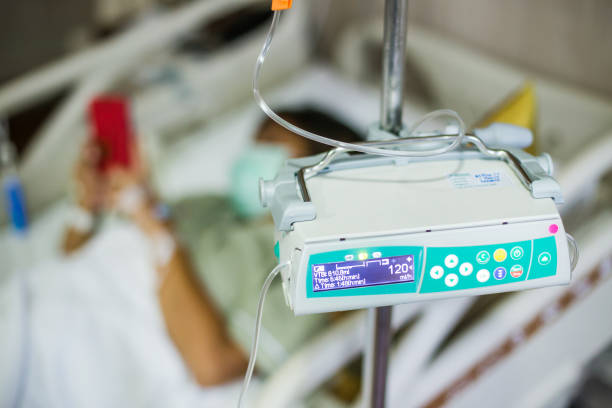
Tämä työtila kuuluu sairaanhoitajakoulutuksen syventävien opintojen
Päivystys- ja tehohoitotyön opintojaksoon. Sen ylläpidosta vastaavat lehtorit
Tiia Saastamoinen, Jenni Tiainen ja Meri Rokkanen.
- Teacher: Kirsi Blom
- Teacher: Meri Rokkanen
- Teacher: Tiia Saastamoinen
- Teacher: Sari Sutinen Sutinen
- Teacher: Jenni Tiainen
- Teacher: Tiina Varamäki

- Teacher (A): Sari Hiitomaa
- Teacher (A): Suvi Kontkanen
- Teacher (A): Mari Lindroos
- Teacher (A): Katja Puhakainen
- Teacher (A): Pia-Marja Vähäkangas
- Teacher: Kirsi Blom
- Teacher: Maiju Salovaara-Hiltunen

- Teacher: Julia Jacobsson
- Teacher: Pauli Ritala

- Teacher: Tuire Ranta-Meyer
- Teacher: Tia Tast

- Teacher: Katja Åker
- Teacher: Katri Kiiski
- Teacher: Lotta Kuosmanen

- Teacher: Katja Åker
- Teacher: Katri Kiiski

- Teacher: Jouni Arffman
- Teacher: Varpu Perämäki
- Teacher: Mirka Peththahandi


- Teacher (A): Aura Kaarivuo
- Teacher (A): Taku Kaskela

- Teacher: Suvi Kontkanen
- Teacher: Kaisa Salmi

- Teacher: Virpi Prieur

- Teacher: Suvi Kontkanen

- Teacher: Katariina Pälli

- Teacher: Linda Dinda
- Teacher: Sari Hiitomaa
- Teacher: Elina Puikkonen

- Teacher: Jaana Meriläinen
- Teacher: Niina Suni
- Teacher: Anne Vähänen

Tavoitteet
Opiskelija tietää terveelliseen ja viihtyisään sisäilmaan vaikuttavat tekijät ja niiden tavoitearvot. Opiskelija osaa määrittää pientalon ilmanvaihtokertoimen ja huonekohtaiset ilmavirrat . Opiskelija ymmärtää rakennuksen energiatehokkuuden ja uusiutuvien energialähteiden käytön tärkeyden merkityksen hiilineutraalisuutavoitteiden saavuttamisessa. Opiskelija tietää yleisimmät pientalon ilmanvaihto- ja lämmitysjärjestelmät sekä vesi- ja viemärilaitteistot, osaa nimetä järjestelmien pääosat ja selittää niiden toimintaperiaatteet. Opiskelija osaa laskea yksinkertaisia LVI-tekniikkaan liittyviä laskuja peruskaavoilla.
Sisältö
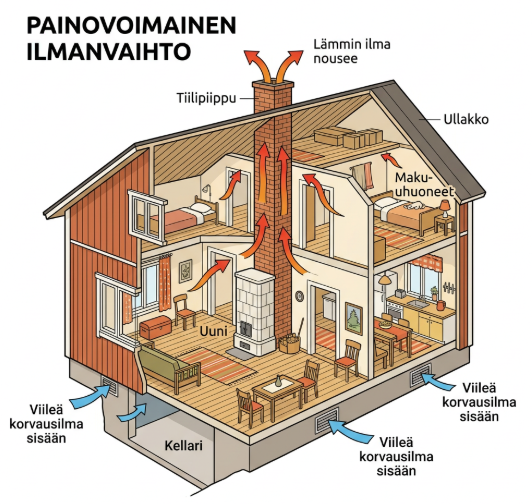
Terveellinen ja viihtyisä sisäilmasto. Ilmavirtojen mitoitus ja ilmanvaihdon ohjaus pientalossa. Korvaus- ja palamisilmajärjestelyt sekä siirtoilmareitit. Painovoimainen ja koneellinen ilmanvaihto. Koneellisen tulo- ja poistoilmanvaihtojärjestelmän pääosat. Ilmanvaihtokoneen, äänenvaimentimien, kanavien, kanavaosien ja päätelaitteiden sijoitus. Kanavamateriaalit, eristykset ja asennus. Ilmanvaihdon ohjaus.
Rakennuksen ja huoneiden lämmitystehontarpeeseen vaikuttavat tekijät. Lämpöpumppu-, kattila- ja kaukolämmityslaitteistot. Tekninen tila. Aurinkolämpö. Vesikiertoinen patteri- tai lattialämmitys. Lämmönjakoputkien materiaalit, sijoitus ja asennus. Lämmityksen säätö ja ohjaus.
Talous veden laatu ja lämpötilavaatimukset. Vesi- ja viemärilaitteiston pääosat.
Työmuodot
Tuntitehtävät
Kotitehtävät
Harjoitustyöt
Excursiot
Aika ja paikka
Lähi- ja etäopetuspäivät kurssin aikataulussa.
Seuraa lukujärjestystä ja tiedotteita, muutokset voivat olla mahdollisia.
Aika Aihe
Ma 28.09.2026 klo 08:00 - 11:00 Kurssin aloitus, tavoitteet ja käytännöt
Ma 28.09.2026 klo 12:00 - 14:00 Terveellinen ja viihtyisä sisäilmasto
Ma 28.09.2026 klo 14:00 - 16:00 Terveellinen ja viihtyisä sisäilmasto
Ma 05.10.2026 klo 08:00 - 11:00 Painovoimainen ja koneellinen ilmanvaihto sekä ilmavirtojen mitoitus, korvaus- ja palamisilmajärjestelyt, siirtoilmareitit ja ilmanvaihdon ohjaus
Ma 05.10.2026 klo 12:00 - 14:00 Painovoimainen ja koneellinen ilmanvaihto sekä ilmavirtojen mitoitus, korvaus- ja palamisilmajärjestelyt, siirtoilmareitit ja ilmanvaihdon ohjaus
Ma 05.10.2026 klo 14:00 - 16:00 Painovoimainen ja koneellinen ilmanvaihto sekä ilmavirtojen mitoitus, korvaus- ja palamisilmajärjestelyt, siirtoilmareitit ja ilmanvaihdon ohjaus
Ma 19.10.2026 klo 08:00 - 11:00 Koneellisen tulo- ja poistoilmanvaihtojärjestelmän pääosat sekä ilmanvaihtokoneen, äänenvaimentimien, kanavien, kanavaosien ja päätelaitteiden sijoitus
Ma 19.10.2026 klo 12:00 - 14:00 Koneellisen tulo- ja poistoilmanvaihtojärjestelmän pääosat sekä ilmanvaihtokoneen, äänenvaimentimien, kanavien, kanavaosien ja päätelaitteiden sijoitus
Ma 19.10.2026 klo 14:00 - 16:00 Koneellisen tulo- ja poistoilmanvaihtojärjestelmän pääosat sekä ilmanvaihtokoneen, äänenvaimentimien, kanavien, kanavaosien ja päätelaitteiden sijoitus
Ma 26.10.2026 klo 08:00 - 11:00 Kanavamateriaalit, eristykset ja asennus
Ma 26.10.2026 klo 12:00 - 14:00 Kanavamateriaalit, eristykset ja asennus
Ma 26.10.2026 klo 14:00 - 16:00 Kanavamateriaalit, eristykset ja asennus
Ma 02.11.2026 klo 08:00 - 11:00 Rakennuksen ja huoneiden lämmitystehontarpeeseen vaikuttavat tekijät
Ma 02.11.2026 klo 12:00 - 14:00 Rakennuksen ja huoneiden lämmitystehontarpeeseen vaikuttavat tekijät
Ma 02.11.2026 klo 14:00 - 16:00 Rakennuksen ja huoneiden lämmitystehontarpeeseen vaikuttavat tekijät
Ma 09.11.2026 klo 08:00 - 11:00 Lämpöpumppu-, kattila- ja kaukolämmityslaitteistot, tekninen tila ja aurinkolämpö
Ma 09.11.2026 klo 12:00 - 14:00 Lämpöpumppu-, kattila- ja kaukolämmityslaitteistot, tekninen tila ja aurinkolämpö
Ma 09.11.2026 klo 14:00 - 16:00 Lämpöpumppu-, kattila- ja kaukolämmityslaitteistot, tekninen tila ja aurinkolämpö
Ma 16.11.2026 klo 08:00 - 11:00 Vesikiertoinen patteri- ja lattialämmitys sekä lämmönjakoputkien materiaalit, sijoitus ja asennus
Ma 16.11.2026 klo 12:00 - 14:00 Vesikiertoinen patteri- ja lattialämmitys sekä lämmönjakoputkien materiaalit, sijoitus ja asennus
Ma 16.11.2026 klo 14:00 - 16:00 Vesikiertoinen patteri- ja lattialämmitys sekä lämmönjakoputkien materiaalit, sijoitus ja asennus
Ma 23.11.2026 klo 08:00 - 11:00 Lämmityksen säätö ja ohjaus sekä talousveden laatu- ja lämpötilavaatimukset ja vesi- ja viemärilaitteiston pääosat
Ma 23.11.2026 klo 12:00 - 14:00 Lämmityksen säätö ja ohjaus sekä talousveden laatu- ja lämpötilavaatimukset ja vesi- ja viemärilaitteiston pääosat
Ma 23.11.2026 klo 14:00 - 16:00 Lämmityksen säätö ja ohjaus sekä talousveden laatu- ja lämpötilavaatimukset ja vesi- ja viemärilaitteiston pääosat
Ma 30.11.2026 klo 08:00 - 11:00 TENTTI

- Teacher: Jarno Hatakka

- Teacher: Pihla Markkanen