
Internet-only source
If you find internet versions of articles, reports and books that are also published in traditional hard copy format, you should use the standard in-text citation procedures as you would for traditional hard copies in your reference list.
If no writer is mentioned in your internet source, acknowledge authorship e.g. write the name of the publisher or, failing that, the title of the publication or two to three words of the title in brackets if the title is long, and the year published if known.
Example 1 - no author
In the example in Figure 1, no author of the online news article is given. The in-text citation for the article is BBC News, 2023. Your reference list entry will give the exact date of publication.
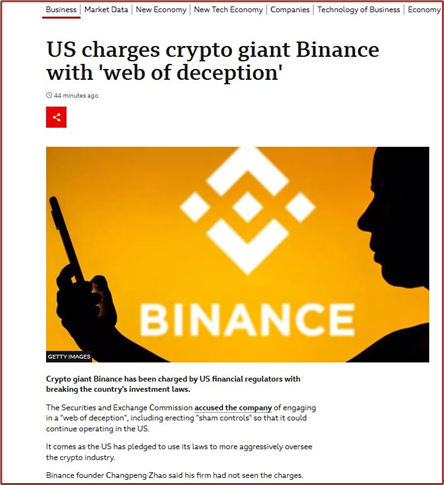
Figure 1. BBC news item (BBC News, 2023a).
According to BBC News (2023), Binance was charged by US financial regulators with breaking the country's investment laws.
Example 2 - author is given
In Figure 2, the online news article has
an author:
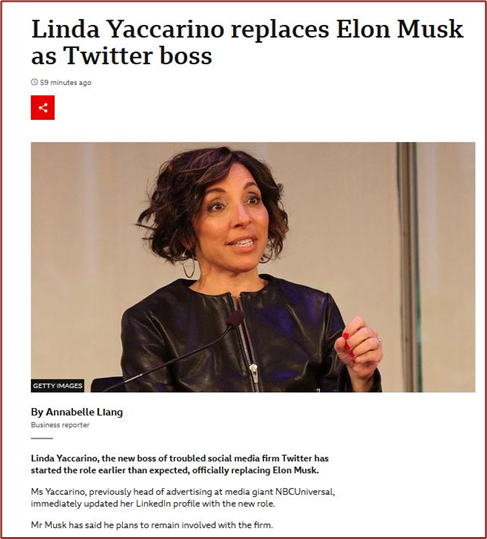
Llang (2023) reported that the new boss of Twitter had updated her LinkedIn profile immediately.
Referring to the same internet source multiple times
If referring multiple times to the same internet source with same date, use a small letter to separate the reference:
(European Commission 2023a)
(European Commission 2023b)
The URL only in the reference list
The URL should NOT be given in the actual text but in the reference list.
According
to the European Commission, the European Green Deal aims to make Europe the
world’s first climate-neutral continent, in part by developing cleaner sources
of energy and green technologies. (https://commission.europa.eu/energy-climate-change-environment_en,
2023.
This should be:
According to the European Commission (2023), the European Green Deal aims to make Europe the world’s first climate-neutral continent, in part by developing cleaner sources of energy and green technologies.